
Jackie Wu on Why Corvus Robotics Manufactures Its Drones in Mountain View, California
Corvus Robotics co-founder Jackie Wu, then CEO, joins Brian Straight, editor in chief of Supply Chain Management Review, to explain why the company manufactures in Mountain View, California, what importing robotics hardware puts at risk and what Corvus One® does inside a warehouse.
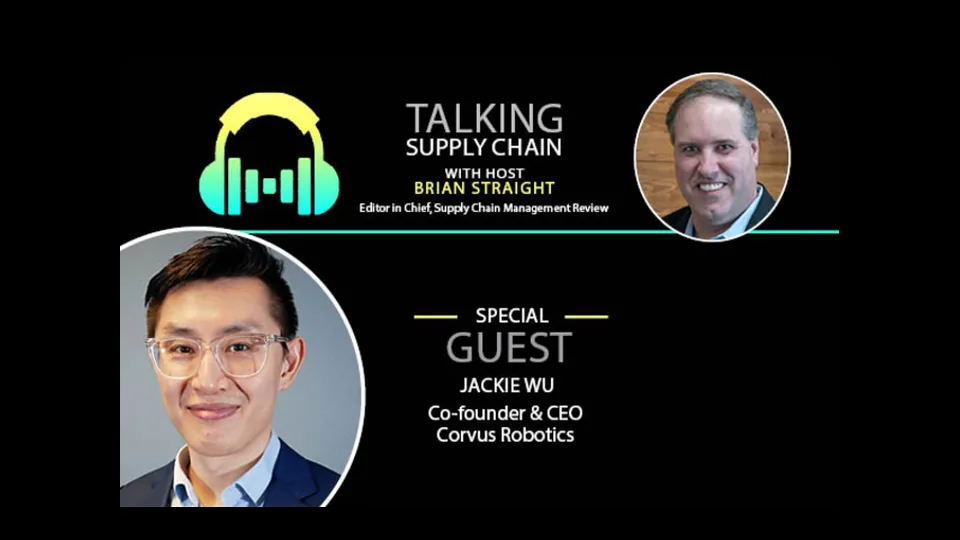
At Corvus Robotics headquarters in Mountain View, California, the hardware team behind Corvus One works down the hall from manufacturing. On the Talking Supply Chain podcast from Supply Chain Management Review, co-founder Jackie Wu told host Brian Straight that keeping the two together lets Corvus Robotics turn what it learns in customer warehouses into the next hardware revision quickly, and he called that iteration speed part of the reason the company wins. Brian Straight introduced Corvus Robotics as the winner of the 2025 NextGen Supply Chain Solution Provider Award for Robotics.
Why Corvus Robotics Keeps Hardware Engineering Next to Manufacturing
Jackie Wu describes Corvus Robotics as a startup still learning in the field. Corvus One deployments now span 26 states, Canada and Mexico, and new requests keep coming in (sometimes from a warehouse associate who walks up with an idea for the next revision). Building in-house gives Corvus Robotics the iteration speed to act on those requests. In his view, a company that hands everything to an ODM, a manufacturer somewhere else with its own hardware team, doesn’t have much control over that team.
“With our hardware team being literally down the hall from manufacturing, it’s very easy to just walk over and talk about this particular build or that assembly or this subassembly.”
Jackie Wu, Co-founder, Corvus RoboticsThen there’s Silicon Valley itself. Jackie Wu says the Corvus Robotics sales team works in the same time zone as engineering, and the area’s network of founders building later-stage AI hardware companies gives him people to trade ideas with, a kind of serendipity he hasn’t seen replicated anywhere else in the world.
What Importing Warehouse Robotics Hardware Puts at Risk
Many warehouse robotics companies, including AMR and AGV makers, manufacture overseas and import their systems, according to Jackie Wu. The risk he pointed to is trade policy: tariffs and geopolitical events that can double or triple the price of imported hardware without warning.
East Asia’s manufacturing value chain is so developed, Jackie Wu said, that overseas quotes for a complex CNC part can beat domestic ones by a wide margin (“5x off here, 3x off there, 10x off there,” in his words), often at higher quality. He also said the U.S. doesn’t have that depth of manufacturing knowledge for every component Corvus Robotics uses, and that a company building a product has to be pragmatic about where each part comes from.
Can the U.S. Compete in Robotics Hardware Manufacturing?
Jackie Wu thinks it can, as long as companies play to their strengths. He sees technologically advanced hardware with high upfront costs (industrial robotics among it) as the category where a U.S. manufacturer holds a real advantage, and he said that reasoning shaped how Corvus Robotics was started and how it runs today.
“If there’s a will, there’s a way, man. I’m telling you, if people have the collective will and want to do this, want to play it straight, want to work hard and do the right thing, why can’t Americans do it?”
Jackie Wu, Co-founder, Corvus RoboticsWhat Corvus One Does in a Warehouse
Corvus One is the first and only fully autonomous inventory management system to fly inside active buildings with no human operators and no localization infrastructure, such as stickers, beacons, or markers. Jackie Wu explained that the drones scan labels at the case and pallet level, which covers palletized and cartonized inventory, spools and individual boxes. He named each-pick e-commerce (think earrings or a pair of headphones) as the use case that isn’t a good fit for Corvus One.
A Corvus One deployment takes one to two weeks, depending on the size of the facility. The drones connect to the customer’s WMS or ERP, and the inventory data, high-definition photos included, is stored on the landing pad’s onboard computer, so it stays on site unless the customer chooses the cloud option. Corvus One navigates GPS-denied warehouses with its own physical AI stack, since metal racking and dense inventory make GPS unreliable indoors.
What Has Changed at Corvus Robotics Since the Interview
Near the end of the episode, Jackie Wu said Corvus Robotics had more product lines coming. In April 2026, the company launched Corvus Trident™, which mounts to forklifts and other material handling equipment to capture pallet movements in real time. Together, Corvus One and Corvus Trident track inventory at rest and inventory in motion.
Corvus Robotics designs the full stack in America, from the sensor and compute architecture to the AI models running on each device. Every Corvus One and Corvus Trident unit is manufactured and tested at company headquarters in Mountain View, California. Read more about why Corvus Robotics designs and manufactures the full stack in Mountain View, California.
Listen to the Full Episode
This episode first appeared on Supply Chain Management Review as “Talking Supply Chain: Made in America with Corvus Robotics,” hosted by Brian Straight, on November 6, 2025.
Full Transcript
Transcript of the full episode, lightly edited for readability.
Brian Straight: Welcome to another episode of Talking Supply Chain. I'm your host, Brian Straight, and I'm glad you're with us today. Today we're going to be talking about something that's come up a lot lately, as reshoring and domestic manufacturing have been at the forefront of conversations, and that is something we might call hardware sovereignty. It's the notion that where we build our hardware, the robotics, the sensors, the machines that are powering modern logistics systems, matters just as much as how we use them. In an age when so many of our automation systems are designed in the U.S. but manufactured halfway around the world, one company is challenging that model. Corvus Robotics, winner of this year's NextGen Supply Chain Solution Provider Award for Robotics, is using technology built here in America and redefining what domestic robotics manufacturing can mean for supply chain resilience and performance. Joining me today to talk about that is Jackie Wu, founder and CEO of Corvus. His company has developed an autonomous drone system that tracks warehouse inventory with precision and speed, giving its customers real-time visibility into one of their toughest challenges: what's actually on the shelves. Jackie, welcome to Talking Supply Chain, and congratulations on your NextGen award.
Jackie Wu: Thanks so much, Brian. Really glad to be here.
Brian Straight: Thank you. I gave a quick look at what Corvus Robotics does, but maybe you could kick off the conversation with a deeper dive into who Corvus is, what pain point you set out to solve when you created the company, and what's the story of Corvus?
Jackie Wu: Yeah. We build autonomous inventory management systems, including drones that help warehouses scan inventory. People don't think much about the physical supply chain until it's cast into the spotlight. But everything around you, the food that you eat, the roof over our heads, the shirts on our backs, all sat in warehouses at some point, and they all have to track inventory. Really, everything in a warehouse flows downstream of inventory accuracy: where they put away, where they pick from, where they replenish. All of that depends on knowing what is where. And so we're on this very exciting cusp of the AI and robotics revolution, where we're able to use the cutting-edge technology we've spent the past ten years researching and developing to help all sorts of large companies in many different verticals (manufacturers, retailers and distributors) track their inventory.
Brian Straight: Yep. We're going to get into a little bit more later on in the podcast about what you guys are doing, but I want to kick off the conversation with the bigger picture, and that is the way I framed it in the beginning, which is domestic manufacturing. So much of robotics manufacturing has been done overseas over the last couple of decades. Why do you believe that building domestically matters now, especially?
Jackie Wu: Yeah, absolutely. I think one of the core beliefs that drives us is that the physical economy is of utmost importance. The other industries, finance, healthcare, services, those are all very important. But for every country, from big countries to small countries, the most far-flung island nations to the smallest microstates, everybody needs physical things. And something that's important is to be able to make some of your own things, so that you're not completely reliant on other folks. One of the views that I have is looking at the economic competitiveness of how you manufacture. There is a value chain that countries move up as they develop and become richer. So in the U.S., we typically don't do much mass-manufactured, low-end textile manufacturing. We're not making Temu shirts or whatever. It's just not cost competitive to do so. But then you look at the inputs, like capital. If something is very technologically advanced, hard to manufacture and requires high upfront costs, the comparison with less developed countries and the cheap labor pool available to them is very different. So you have to look at the economic structure of a country when you think about how to manufacture. And that's the sweet spot that we're manufacturing in: high-end robotics, where we have a competitive advantage, where there is a true differentiator, and it's not a consumer, mass-produced type of good.
Brian Straight: Yep. So when we think about domestic manufacturing, as you mentioned, textiles, right? We're not making the shirt on your back here in this country, typically. Sneakers are another thing. A lot of the conversation around domestic manufacturing centers on semiconductors or EV parts, things like that. But you're saying that same value applies to robotics hardware as well, then?
Jackie Wu: Yeah. I can only speak to our industry, my industry of robotics and industrial hardware. There are a few companies that have basically vertically integrated a lot of their complex manufacturing here in the U.S., and we really look up to them. They've been nice enough to let me visit some of their factories. It's very interesting. It is this fully vertically integrated stack where they have manufacturing cells, and it's just a machine that is churning out more machines. So that's the vision for us. We automate, but we're also on our own automation journey, to manufacture with our competitive advantages, with high technological inputs.
Brian Straight: So the things where machines can do some of the work, automation, they're not labor-intensive products.
Jackie Wu: Yes, that's right.
Brian Straight: Thanks. So there are certainly a lot of companies that still import robotic systems or components into this country. From your perspective, you guys are choosing basically not to do that. So what kind of risks are presented if you do decide that you're going to import these components or these systems? Is there additional risk that you take on as a company when you import?
Jackie Wu: Yeah. I think every one of the robotics companies in the warehouse inventory robotics space, and certainly many of the other AMR and AGV companies, manufacture their robots overseas and import them here. And I think the risk there, of course, is the same that we've seen for the past few months. There may be unpredictable trade policies and tariffs and geopolitical issues that cause uncertainty, or double or triple the price unexpectedly. And fortunately, that's not something that we directly have to face, because we manufacture over here. But there always is that unpredictability of political events affecting the global supply chain that we must intelligently manage.
Brian Straight: Yeah. So I want to go back to the beginning here, when you made this decision to do the work here in the U.S. I think it's easy, especially for young companies, startup companies, to go where the cheapest option is, because you're trying to preserve cash and use it for other things. So can you walk us through what led you guys to the decision to say, hey, we want to be here in the U.S., we want to make and build in the U.S.?
Jackie Wu: Surprisingly, some of it is that overseas, in East Asia, the manufacturing value chain is so developed and advanced that it's really hard to imagine by comparison over here. One should see it for oneself. I believe strongly that one should be able to think for oneself and see with one's own eyes. But a lot of that manufacturing value chain is very advanced, and it's not only cheaper, it's actually better. The quality is better. So when we're getting quotes to CNC some piece with some kind of complexity, whether it's from somewhere local here in the U.S. or somewhere overseas, and we're comparing quotes, timelines, service and cost, it really is no comparison. It's 5x off here, 3x off there, 10x off there, and it's just like, oh my gosh. So it's tempting to look at that. But there are just so many things that are out of your control, to your point. As a startup, we're moving very quickly, and there are things that we're learning in the field about the customers. Even now, our robots are deployed in the vast majority of the states of the United States, and there will be new things that we uncover and develop, and we're like, hmm, that's an interesting idea, we should implement that for the next revision. Sometimes even a warehouse associate will come up and say, hey, it would be great if we could do this thing, and we're like, yeah, that's actually a really good point, we should look at that. So being able to do a lot of this in-house, to quickly iterate and have that iteration speed and cycle, I believe is part of the reason why we win. If you just outsource everything to an ODM, a manufacturer somewhere else, and their own hardware team, you don't have much control over them.
Brian Straight: So I'm hearing proximity in your answer. It's proximity to the designers, to the manufacturers, to building the product. Speed being an issue here, working closer with suppliers. Those are some of the advantages, I assume. Are there other advantages you have by being local? I think you hinted at this a little bit, that things change and you learn things from your customers, their needs and wants. Is that stuff easier to do when you're dealing locally, meaning domestically, with suppliers, instead of trying to deal with a supplier in another country?
Jackie Wu: Oh, yeah. Absolutely. We've all had the late nights. 9:00 p.m. is morning in another time zone, and you're getting up to talk to someone. It obviously is much easier if somebody is domestic, just from a sleep perspective. But just being able to talk the same language, the same culture, all of that makes things a lot easier. So there is an added benefit there. If it was an apples-to-apples comparison, there's no question that we would love to work with somebody local. But do we have the manufacturing? Do we have the value chain near us to do it? It's not about just cheap labor anymore. It's really about the expertise, the depth of the manufacturing knowledge and the network. Do we have that here for all of our components? The answer is a hard no. It is very clearly no. And so you have to be pragmatic when you're actually building a product. That's just how it is.
Brian Straight: So I just want to ask you one more question on this, and then we'll get into some of your actual technology and what you guys are doing. And that is your culture of innovation. You touched on this. Does building domestically shape the culture of innovation? Does it improve the innovation that you guys are able to do, the way your engineers are able to think? Maybe there's more back and forth with customers, or what have you. How does being local, if you will, shape that culture of innovation that you guys have at Corvus?
Jackie Wu: Yeah, I think that's key. We're based here in the heart of Silicon Valley. I'm not a California native. I did not grow up here. I grew up in Texas, and my co-founder and I were up in Boston when he was still in school. We moved out here to California a couple of years ago. And I think there really is some magic in the air over here, whether you're building software or hardware or AI. I think people work hard regardless of where they are. But I do believe that people work more effectively, somehow, here in Silicon Valley, at least for startups and innovation. It's something in the air, something in the water, Brian. I don't know what it is. But, of course, with our hardware team being literally down the hall from manufacturing, it's very easy to just walk over and talk about this particular build or that assembly or this subassembly. That just makes it so much easier. And being able to hear from our sales team in the same time zone what is going on, all of that makes it much easier. And then we're blessed in that some of the friends I've bumped into in the area are just amazing, building even later-stage, successful AI hardware companies. You can just talk to them and share thoughts back and forth. That's a network that allows for serendipity and fortune that I have not seen replicated anywhere else in the world.
Brian Straight: The coffee shops in Silicon Valley are fabulous, right? You get into those coffee shops with all the different people from the different companies, and you just hear the conversations and the things that go on. When you connect with people out there, there's just so much innovation that takes place in that area.
Jackie Wu: For real. These days it's like boba shops, which is not good for my teeth. Crazy stuff.
Brian Straight: I want to shift to your actual technology and talk about what you guys are actually doing out there. So why don't we start with this: for those unfamiliar, can you talk about what the Corvus system actually does in a warehouse environment? What does it actually accomplish for a customer?
Jackie Wu: Yeah. So our first product line is Corvus One. They're the world's first fully autonomous drones. These are self-flying robots that shoot lasers to count your inventory. They don't need people to fly them or to follow them around. You don't have to put up tens of thousands of stickers or hundreds of beacons on your ceilings or anything like that. So these are small, lightweight aerial robots that help track inventory. I don't know how much familiarity folks have with cycle counting in a warehouse, but the way that inventory has been tracked for the past couple thousand years is a person walking around with a barcode scanner and a printed-out or hand-scribbled task list, trying to match inventory. It's a very slow process. That person only covers 1% of the warehouse a day. These are massive warehouses, the size of five football fields, going up four stories high. And if you think about AI and robotics, sometime in the future, people are not always going to be using handheld barcode scanners and tablets to check inventory. Sometime in the future, it's going to be a robotic, computer vision and AI solution. And that day is now. So we have this core autonomy physical AI stack that we've spent about a decade building and refining specifically for warehouses and factories. We went in with a very specific use case for a specific type of customer to solve this problem. So it's not a generic, off-the-shelf SLAM model. It's something that we've built with warehouses in mind. So that's the first product line. These drones set up quite quickly, in about one or two weeks, depending on the size of the facility. And then we're able to fly and figure out what SKU is where quite quickly. There are a few other things coming down the pipe. But what customers know us for, what they trust and what their independent auditors verify against is that drone data, which supplements the team of cycle counters by doing it 10 times, 20 times faster.
Brian Straight: Yeah. And I guess if you think about it, if you've got a 100,000-square-foot warehouse or a 500,000-square-foot warehouse, and it takes you 30 days to truly map everything that's in it and count everything in it, in this day and age, where everything moves so quickly, especially with e-commerce, you're never going to have an accurate inventory if you do that. So if you have a system where you can do that quicker, certainly I would think that would improve your accuracy. And inventory counts matter for money, right? I mean, companies, if you have inventory that you don't actually have, you're paying taxes on that inventory. And if you don't actually have it, that costs you money. So what type of facilities right now are you seeing the greatest benefit with this system? And what kind of ROI or efficiency improvements are your customers reporting when they install something like this?
Jackie Wu: Our customers span all different types of industries, pretty much every vertical: automotive, aerospace, household appliances, medicine, food, grocery, beverage, CPG, consumer-facing stuff, industrials, power equipment, manufacturing and so on. I would say one use case that's probably not very good is each-pick e-commerce. Just imagine a fast-growing e-commerce brand, consumer facing, selling something small, and they need to pick these small things. The drones are scanning at the case level or at the pallet level. So if it's a small pair of headphones or some earrings or something like that, that's not a good use case. But for all these other things that are palletized, cartonized, spools, individual boxes, we can save you money and do it better. So that is the double whammy of the quick ROI.
Brian Straight: You mentioned little things like that, but you also mentioned automotive, so I just want to ask you specifically about that. Does it require the items to be in boxes to be able to count them? Because a lot of automotive parts may just sit on shelves, not in boxes.
Jackie Wu: Yeah. No, they don't have to sit in boxes. Things should be barcoded. They should have some kind of label, obviously. You're going to have that yourself for your warehouse, or else how the heck are you scanning it today? And these are really large warehouses where organization does matter, and we can help with some of the change management and the process improvement, making sure that labels are being affixed properly, that they're facing outward and so on. The drones can detect all of that.
Brian Straight: Okay. So as you're collecting all this data, which is fabulous, you're collecting all this inventory, you know what's here. What's happening with that data? Are you connecting with the warehouse management systems or ERP platforms, and what happens at that point when that connection takes place?
Jackie Wu: Yeah. So yes, we do connect with the WMS or the ERP, pretty much every one of them. We're partners with some of the largest WMS providers, and we also work with homebrew, homegrown, niche WMSs that some team has built. And it's a pretty simple comparison, because it's really what is where, when. That's what goes between the WMS and our system. We provide the software UI, obviously, for our customers to quickly analyze that inventory, and they get these summaries up front. But there's a lot of rich data in our platform that's not captured by the WMS: pictures, videos, high-def pictures, all these analytics using computer vision and AI. That's in our platform, and people are able to use it to see if there really is inventory in a particular location, because the drone flew there 20 minutes ago, as opposed to sending somebody on the floor to do a floor walk for the next 40 minutes, looking at ten locations to try to find the SKU. But what's interesting about the way that we manage this is the reality of internet connectivity in most of the warehouses that we've been in: it's just not very good. Signal attenuation. There have been a few warehouses that have great internet, and I'm like, I don't know how you guys are doing this. But most warehouses have pretty [bad] internet. And so what we do is we actually keep all of the customer's data on-prem. They have control over it. It's not sent to the cloud unless they want it to be. That's a separate option. And on cybersecurity risk, it's not going to a multi-tenant, overseas data provider or whatever, because our landing pads have these powerful computers with a lot of storage that allow their inventory data to be securely hosted on site. That's something that a lot of customers like and appreciate, being able to just quickly access this on site without worrying about the IT implications of going to a multi-tenant cloud.
Brian Straight: Yeah. So if the Wi-Fi, I should say, is not great in a warehouse, then your drones are collecting the data and then downloading it, basically, when they get back to the landing station?
Jackie Wu: Yeah, that's right.
Brian Straight: So there's a slight delay there for a customer, potentially, if they don't have the Wi-Fi connectivity.
Jackie Wu: Oh, that's fine, because there are timestamps. So you know exactly when something was there, and you've got picture proof. But yeah, we don't need Wi-Fi to fly or to operate. You don't need to pray to the Wi-Fi deities for connectivity to keep your robot working.
Brian Straight: Okay. So the drone is flying, too, without the Wi-Fi?
Jackie Wu: Yes, exactly.
Brian Straight: Is that GPS-enabled? How's it...
Jackie Wu: No. So GPS doesn't work super well in these facilities, because you've got to imagine these are big warehouses, often with big metal racks and lots of dense material everywhere. GPS just is not very accurate. If I'm walking downtown in a city, my GPS is not accurate because it's bouncing around the skyscrapers or whatever. In racks, it's even more so. So we have very precise location of the drones using our proprietary physical AI stack. You can think of it as a self-driving car that fits in the palm of your hand, and it goes in 3D space, not just 2D, using sensors that look around the environment.
Brian Straight: Gotcha. All right, I want to get two more quick questions in before we wrap up. One, I want to go back to the initial theme of this, domestic manufacturing. In your mind, can the U.S. regain leadership in hardware-based innovation, things like robotics and sensors and automation? Or are we a software country, if you will?
Jackie Wu: If there's a will, there's a way, man. I'm telling you, if people have the collective will and want to do this, want to play it straight, want to work hard and do the right thing, why can't Americans do it? We're all just people. There's no difference between us and really anybody else. So I think if people really have that will, they can. I think playing to one's strengths is also important. You don't want to enter a competition in which you are destined to lose. You want to look at your advantages and think carefully about where you are strong, what kind of environmental factors can make you succeed, and then once you're sure of that, take that approach. That's how we started this company, that's how we're running it, and that's how we're seeing the success that we are today. But it really does require playing to your strengths. Like I said earlier, unless there's some kind of major breakthrough that I'm not aware of, America is not going to do much of the low-end manufacturing. It just doesn't make economic sense when your cost of electricity competes with the price of labor in a developing country. So you do have to look at the high-value-add type of goods, make the investment, make the bold bet, and work on making that business actually work out.
Brian Straight: Yeah. Isn't that almost the perfect parallel to when you build a company or run a business? You do what you excel at. And what you don't excel at, you understand that, and then either become an expert in it or find somebody who is an expert in it.
Jackie Wu: Yeah, absolutely. I fully agree. Putting on my amateur armchair geopolitician [hat], I think countries work in a similar way. We all hope for world peace and to get along. But there is a world in which we partner with folks, in which we do what we are good at and somebody else does what they are good at, and there's overlap in which we can build that type of mutual, positive, win-win relationship. It's all about that. It's all about finding how you can win and how they can win, where they're strong in the areas where you're weak, and vice versa.
Brian Straight: Yeah. The final question to wrap up, I just want to give you a chance: what's next for Corvus Robotics? How do you see warehouse automation evolving in the next few years? What's next for you guys going forward?
Jackie Wu: For us as a company, we're seeing extremely rapid growth, and it is deserved. It's on the back of a foundation of ten years of R&D, and once we launched the actual product, people were like, yes, of course, this solves a pain, this helps us. In the short and medium term, there are some additional product lines that are very exciting, that can also be quite large and solve big problems inside the four walls. Longer term, there are some research areas that we're seeing now, just as we saw almost a decade ago, that will be ripe in a few years. So we're starting to build the foundation for the future as well. But ultimately, we want to be of service. We want to be of help to the world, to the physical supply chain, the people, the companies, the consumers and recipients of that. I think we can make the world a better place by getting people the physical things that they want. So that's what we're working toward.
Brian Straight: Great. Jackie, thank you. A great conversation. I think you guys are a good example of how you can build and manufacture domestically as long as you're solving a pain point for somebody. That's the key. It's not just manufacturing domestically, it's solving a pain point for organizations, and you guys are a good example of how you combine those two and find success doing so. So thank you so much for your insights and for sharing a bit of the Corvus Robotics story. If people want to connect with Corvus, maybe they have pain points themselves they want to solve, what's the best way for them to get in touch with you guys?
Jackie Wu: LinkedIn or our website, corvus-robotics.com. I think regardless of how you misspell that, you'll still land there. Or corvus.ai, C-O-R-V-U-S. We'd love to see if we can help. That's why we exist.
Brian Straight: Great. Thank you so much again, Jackie, for joining us, and congratulations again on your NextGen Supply Chain Solution Provider [Award].
Jackie Wu: Appreciate it.
Brian Straight: We are out of time. I want to thank my guest today, Jackie Wu from Corvus Robotics, and all of you who took time out of your day to listen to us today. We greatly appreciate it. New episodes of Talking Supply Chain come out on Thursdays. You can find them on scmr.com or wherever you get your podcasts, so be sure to subscribe so you never miss an episode. Until next time, this is Brian Straight, and you've been listening to Talking Supply Chain.
More News & Content
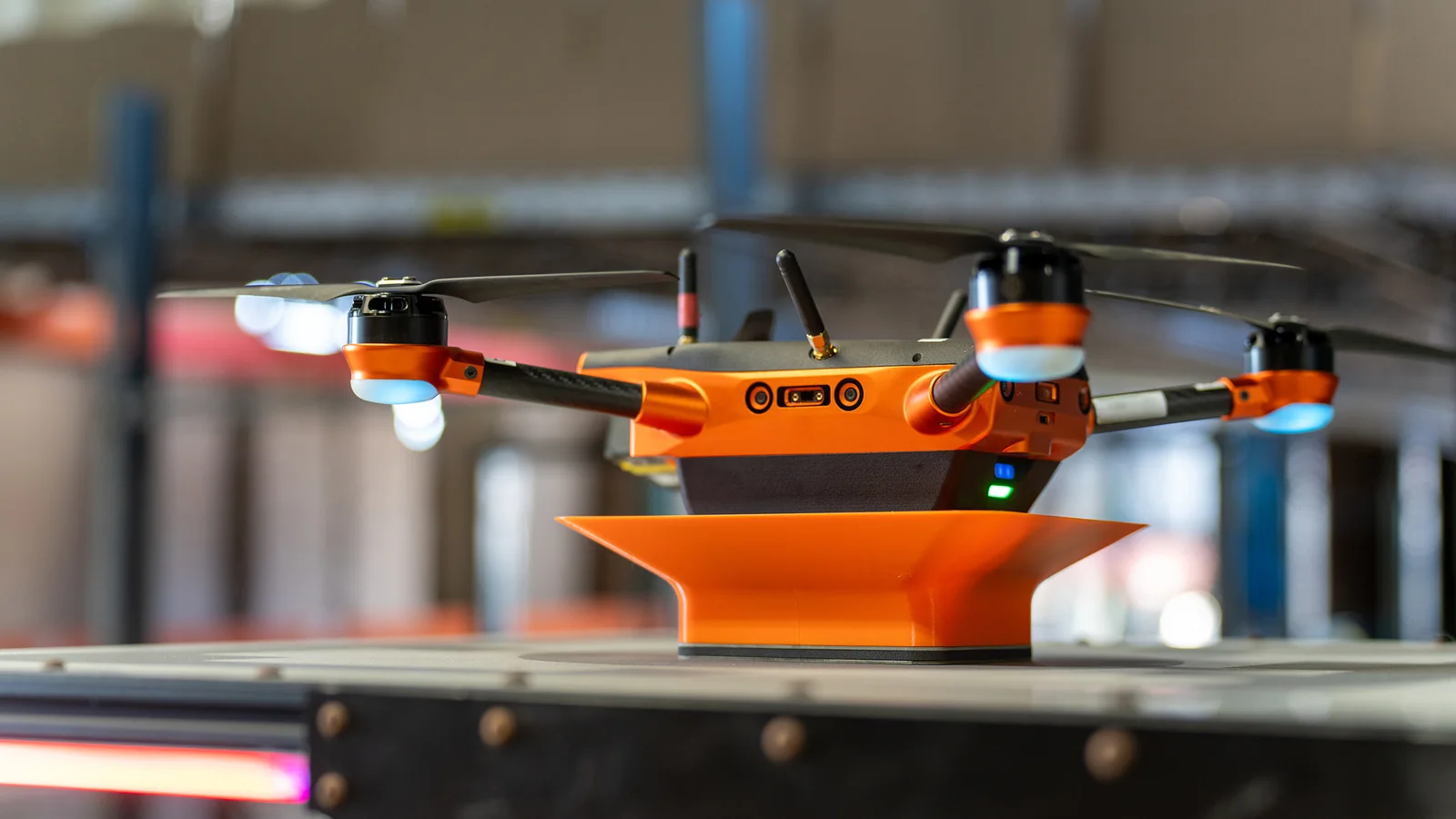
American Made Warehouse Drones: Why We Design and Manufacture the Full Stack in Mountain View, California
Software in a robot is limited by the hardware it runs on. Why every ceiling in the product is set before anyone writes a line of inventory logic.
September 17, 2026
Autonomous Drone Inventory Management on The New Warehouse Podcast
Jackie Wu joins Kevin Lawton for episode 569, on building drones in California, deploying without beacons or markers, and what a counting pass surfaces beyond the count.
March 10, 2025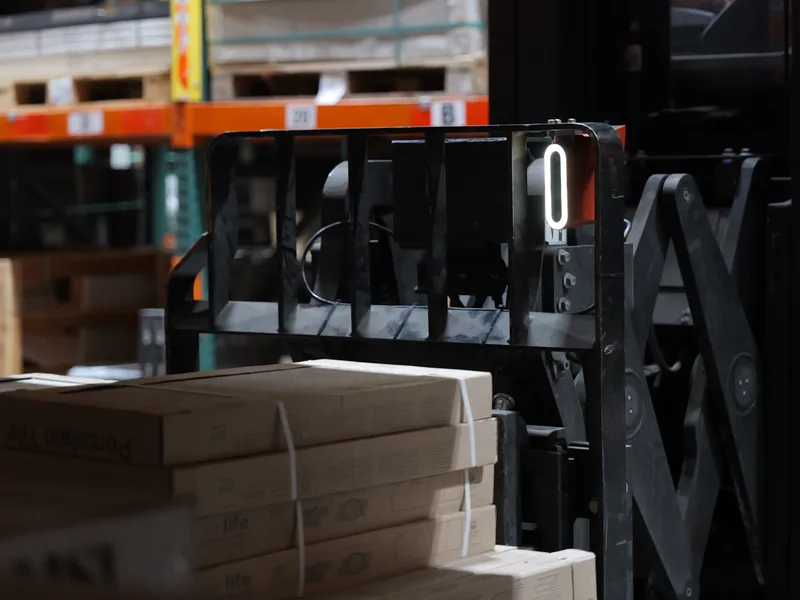
Corvus Robotics Launches Corvus Trident™, an AI Copilot for Material Handling Equipment
Mounted to forklifts and reach trucks, Corvus Trident captures pallet movement automatically from inbound through outbound.
April 13, 2026